Project Overview
CHALLENGE
Design a portfolio-like platform for VR where 3D environment artists can present their work in an immersive way.
SOLUTION
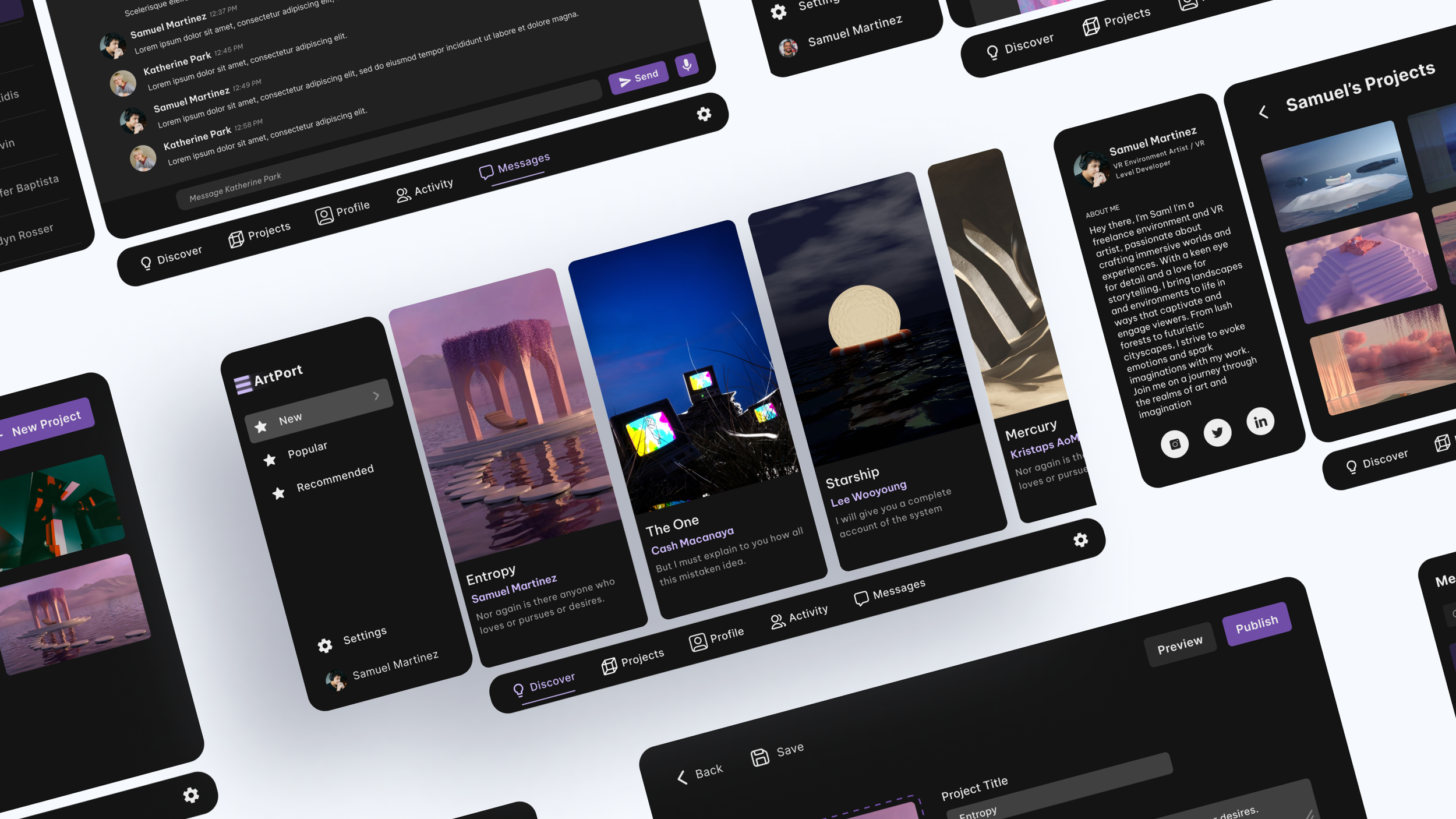
ArtPort is a VR portfolio platform that gives artists the ability to display and showcase virtual 3D projects and art by taking advantage of the immersive nature of Virtual Reality.
MY ROLE
UX, UI Designer
User Research, Visual design, Prototyping & Testing
TIME
August 2022 - December 2022
TOOLS
Figma, Unity, Procreate
PROJECT BACKGROUND
This project was researched, conceptualized, and designed in a semester long User Interaction Design Studio at the Georgia Institute of Technology School of Industrial Design. This project encompasses the whole UX Design Process starting from research and definition, through concept development and prototyping, ending with user testing and brand/visual design development.
Design Process
EMPATHIZE
Research
Through market research, competitive analysis, and user interviews, I set out gain a deeper understanding of the market for VR and digital art.
Research Goals
To streamline my research process, I established clear goals and created a research plan that would guide the process.
Identify competing portfolio platforms and evaluate strengths and weaknesses
Discover pain points that both artists and the audience encounter
Understand engagement and immersion with digital VR art
Understand how different levels of immersion evoke emotion for VR users
Understand the relationship between digital artists and their audience
Preliminary User Interviews
To begin my discovery research, I interviewed a variety of individuals ranging from people who only had experience with physical art in museums to digital/VR art enthusiasts. I also interviewed several digital artists to discover any possible pain points or needs in their creative process.
During these interviews, I asked open-ended questions to learn as much as I could about their experiences and identify what the user’s needs truly are.
I conducted interviews with 8 people, about 45 minutes - 1 hour each.
Some questions asked during the interview:
Tell me about how you typically discover new VR art?
What motivates you to seek digital art as apposed to traditional art in a museum or exhibit?
Would have the same experience viewing VR art as you would viewing a canvas art?
In a virtual space, would you rather see 3D pieces as opposed to a traditional gallery setting?
What would help you better connect with art pieces in a virtual space?
Do you want to connect with or understand the creator of VR/digital art?
TAKEAWAYS
“Phygital” Experiences take away from Artist’s intention
Modernization of historic art takes away from the original emotion and meaning of the art piece
New mediums are needed for new modes of art
Canvas art is best viewed in person, but does not read off well in virtual and digital recreations.
Even if something isn’t 3D, perceived physicality reads off better in VR
3D pieces are more interesting to view in VR environments
Sense of community desired but is hard to replicate
Museums provide a sense of community that digital experiences take away
Preliminary Artist Interviews
After interviewing potential users, I interviewed three 3D environment artists/engineers to discover any pain points or needs they may be encountering.
I conducted interviews with 3 people, about 45 minutes - 1 hour each.
Some questions asked during the interview:
Can you share your process of compiling and uploading your work for display?
How do you incorporate aspects of storytelling in your work?
What platforms do you use to showcase your 3D work?
How can platforms better connect you with your audience/potential audience?
TAKEAWAYS
“Industry standard” portfolio platforms takes priority
Most artists already use portfolio platforms that are considered as the industry standard/most recognized even if it doesn't suit their art form.
2D images is the most convenient for recruiters and employers.
Their portfolio consist of 2D images because most job recruiters or clients don’t have either the luxury or the time of putting on a VR Headset for viewing.
Storytelling is key, but is greatly hindered by 2D images
Artistic freedom and versatile storytelling is incredibly important, but so much of the story dies when condensed to a series images.
Competitive Analysis
Based on the responses during the interviews, I recognized that the artists had a big gap in their process: portfolio platforms limit their ability to show the world their work!
I started to research the main portfolio platforms my interview participants were familiar with and used.
Persona Archetypes
Using the insights gained from interviewing the different groups, I created archetypes of persona to potential users. These personas represent the different types of participants I interviewed during my discovery research.
Empathy Map
Using an empathy map, I synthesized all the information I gathered during the user interviews to uncover key insights.

Patterns
From the empathy map, I categorized the responses into four common patterns that helped me pull insights and needs from my interviews.
Discovery Challenges
Many people expressed that they didn’t know where to go to find new projects.
Desire for Community
Many expressed wanting to find a group of like-minded individuals.
Desire for Innovation
Many expressed that they’re eager for the next new trend.
Emphasis on Storytelling
People want to feel connected with the artist through a cohesive story.
Insights
People are drawn to platforms that align with their interests and preferences.
People love seeing innovation, but when it’s applied where it wasn’t needed or asked for, it feels disingenuous.
People value community and networking especially so in a digital landscape.
People are motivated by their imagination, fueled by storytelling.
Needs
To showcase immersive artwork effectively, entirely
To collaborate and share knowledge within a community
To engage with environment art and VR experiences
To experience genuine, meaningful storytelling.
User Persona
Meet Samuel! The representative of the target user. Through my secondary and primary research, I created a persona that would accurately represent and describe the target users. Samuel will be my guide as I begin to make design decisions.
DEFINE / IDEATE
Defining the Problem
To help define these problems, I used the insights gained from research and interviews to create a user story to frame the problem from Samuel’s POV.
Information Architecture
Site Map
Task Flow
User Flow

Lo-Fi Wireframes
Design / Prototype
Building a Prototype
I developed the low-fidelity wireframes into a prototype to be able to test with real users that the design decisions made thus far actually made user needs that came up during my research phase.
Lo-Fi Digital Wireframes
Mockups
I used the 2022 FloatGrids XR/VR design system to fully visualize the design concepts and translate the low-fidelity wireframes into a more tangible product. This is the third iteration of mockups that I designed, developing and improving on previous designs.
Feedback and Priority Revisions
Better Navigation Bar
The overall visual design of the navigation bar felt awkward due to excessive empty space on either end. Additionally, stacking icons onto text created a cluttered appearance. To address these issues, I adopted the Floatgrids 2024 design system's navigation bar, which offers a cleaner, more user-friendly look with clearer text.
Old Navigation
New Navigation
Thumbnail Format
Through feedback sessions, users expressed a desire for more than just a two-column thumbnail layout. They felt that the scale of the thumbnails made scrolling feel slower. To address this, I changed the design to display more thumbnail previews at a time. Additionally, I simplified the overall design and optimized the space used.
Old Project Manager
New Project Manager
Final Mockup
For the final mockup, I updated the design system to the most recent version of FloatGrids in 2024 to iterate and improve the user experience and visual appearance of the overall UI.
Reflections and Takeways
This project, first started in 2022 and later updated in 2024, was my first venture into User Experience design. I explored new design methodologies for this project to put more focus on the logical structure of the product’s experience before finalizing the visual design. This method was really effective in quickly identifying user goals, needs, and design challenges. If I were to continue iterating this design and push further, I would consider the following:
01 FEASIBILITY
My original intention was for this to be a VR centered platform, compatible with PC. However, I possibly need to reconsider this outlook for accessibility and development purposes.
02 DESIGN HANDOFF
After user testing and iterating a finalized version of the design, I would then present the final design to stakeholders and hand it off to developers to develop the UI within Unity.
03 RE-TEST
Now that I’ve made a 2024 iteration of the design, I would like to test and validate the design changes made and observe if any further improvements need to be prioritized.
04 TESTING IN VR
I have so far only received feedback by showing potential users the screens via flat images/prototypes, but testing the product directly in VR would offer different results and insights.